Saturday, 9 May 2015

The narrative of election victories

The results of the 2015 UK General Election have been described as extraordinary now more times than I can count, and everyone is scratching around for explanations as to why the pollsters got it so wrong and why two neighbouring countries with a shared heritage should have elected two such entirely different sets of political representatives- broadly, England (except for London) going Tory/UKIP and Scotland going to the left of Labour.

(One VERY important caveat here, by the way. Though Cameron's victory is being hailed as if it were virtually unanimous, his party received well under 40% of the vote and still has a majority slimmer than John Major's in the 90s. Still...)

The SNP whitewash has been categorised south of the border (and particularly by the tabloids) as a nationalist, anti-Union and even anti-Labour surge but actually it seems to have been in a sense more extraordinary than that. A country which has always been if anything more socially conservative than its neighbour has apparently swung politically to the left of the most left-wing of the UK-wide parties. The SNP is anti-Trident, anti-austerity, pro-progressive taxation and increased welfare spending and pro-immigration. The Siriza of the UK, or more akin to pre-Blair Labour than anything else. The Tories whom the English elected, meanwhile, argue for reduced taxation and the taking of a flamethrower to the Welfare State.

So how did that happen? One argument of course would be that the Scots have, en masse, moved politically to the Left whilst England (and Wales, it appears) have moved to the Right. To some extent this is no doubt true, but in a sense saying that does no more than restate the original question, with no real explanation. So why has it happened?

Well, one explanation, that is appropriate to the (vague) themes of this blog is the issue of narrative. I have argued before (here for instance) that there is a strong narrative imperative in the way we view the world. As a species we use narrative to construct and inform our view (political and otherwise) of the world, and a simple, clear narrative is more powerful than any logical argument, however clearly stated. And it seems to me that this election has shown that fact more clearly than ever, because the parties that won were the ones with the clear narratives.

First, the Tories. Like any political party facing an election it presented the electorate with a hero quest narrative and they did it very well: there was a goal (the Long Term Economic Plan), a serious danger to escape from (the nameless horrors of the global economic crisis), a villain (the Labour party, which single-handedly, recklessly and with malice aforethought created that global economic crisis), various perils to be navigated (Europe, immigration, financial perdition) and of course an element of comedy (Ed Miliband). Essentially of course there was a hero (David Cameron). I will come to the hero bit in a minute, but it is worth pointing out that there was even a mini-narrative for the election campaign itself (Lynton Crosbie's assertion that polls would not budge until a sudden last-minute swing when people realised they couldn't afford the Miliband risk) and a useful prop (the jokey note to a 'friend' left by the Labour finance minister).

The SNP had an equally strong hero quest narrative. They also had a goal (the establishment of a Scottish Shangri-La), a serious danger to escape from (austerity and the Tory dismantling of the Welfare State) and a villain (a three-headed monster, the ThatcherBlairCameron). Their unexpected, but archetypally Scottish, heroine was Nicola Sturgeon, a feisty wee woman who rose to superstar status.

The UKIP narrative started simple and direct (I have just eaten, so really don't want to spell it out) but began to lose its clarity as Farage back-pedalled from some of the more extreme crap spouted by supporters. It is maybe for that reason that, thank God, UKIP began fading in the polls and didn't achieve their breakthrough.

So what of the losers? Well, I don't think I am the first to point out that neither Labour's not the LibDem's narrative was in any way clear or comprehensible. The LibDems villain was (sort of) the coalition partner they had been in bed with for five years. The danger to be escaped was both (sort of) the same as the Tories' and (sort of) the Tories themselves. Labour's danger to be escaped was in some ways their own past in government (never a strong start...). Business was both a villain and an ally and the prop they used to counter the Tories' treasury note was both literally and metaphorically a tombstone.

(On a side note, it is quite extraordinary how Labour failed to construct a coherent narrative out of the Tories' record, with its failure to eliminate the deficit, bring down immigration or protect the NHS from top-down meddling. It is also extraordinary that they only once seemed to mention that the bogeyman economic crash was brought into existence by policies on bank deregulation that the Tories of the time condemned as not going far enough!)

The disappointing performance of the Greens was another illustration of the narrative imperative. The key moment was Nathalie Bennett's 'brain-melt' in that LBC interview. This was presented as going to the trust issue- that potential voters lost trust in her competence- but I think it was simpler than that. Her inability to recall her party's policies on social housing showed that she had quite literally lost the plot (or forgotten the narrative she was attempting to outline). The Greens have always presented a clear narrative (danger to be avoided- environmental catastrophe and villain anyone who recklessly pursues economic growth) but this time they seemed sometimes to forget themselves what it was and they paid the price.

So what of the heroes of these respective narratives? There is not much point discussing the inadequacies of Clegg and Miliband in that regard. Flawed heroes are all very well in literature, but not for politics. Miliband came across as a decent, well-intentioned geek, Clegg as an unprincipled, power-hungry wannabe, but what they had in common was the fact that both lacked an indefinable something that both Cameron and Sturgeon (for all their diagrammatic dissimilarities from each other) had in spades- self confidence. Clegg knew that the fresh promise he had held out in 2010 was tarnished beyond repair by the student fees betrayal (and more) whilst Miliband was, and no doubt still is, in some sense still the nerdy boy who used to shut himself into the library of Haverstock School every lunchtime.

So what about Cameron and Sturgeon? Well, both had one enormous thing in common: neither had anything like as much to lose as either Miliband or Clegg. Cameron had already announced he would not be standing again after this election and Sturgeon wasn't standing at all. For Sturgeon, anything even vaguely close to what the polls were predicting was always going to be a vast improvement on any previous SNP performance and for Cameron, even if he lost he could pretend that he had sacrificed himself and his political career in the greater national interest and laboured on with the politically unpopular 'tough choices' that only he was brave enough to make (sorry- had to stop for a while. I feel a bit sick).

But there is something deeper still about the nature of both of these heroes. Utterly different in almost every ways, their cultural heritage has gifted both of them a sort of fearlessness that removed the self-doubt which condemned Clegg and Miliband to oblivion. Cameron's fearlessness is born of entitlement- the utterly impervious arrogance of the public school elite, which I have discussed here for instance. This innate self-confidence was boosted by the fact that I really don't think that he (or Gideon or the rest) actually care that much. They haven't got Thatcher's passion or Blair's messianic zeal. They're just doing it all for kicks.

Sturgeon has a different sort of fearlessness. Her's is the 'fuck it, why not?' of the perennial Scottish underdog. She is an Archie Gemmill for the 21st Century, nutmegging the Dutch goalie as Scotland celebrated yet another heroic sporting failure at the 1978 World Cup. She (and all Scotland) knew that however many SNP MPs they sent to Westminster it was unlikely to make a lot of difference so they really had nothing to lose, and God, did she make the most of it.

So how important is this sort of fearlessness to elections in general? Utterly crucial, unfortunately. Thatcher had the fearlessness of the zealot while Major was racked by self-doubt and tempered by reasonableness. Blair was positively Messianic whilst Brown was clearly tortured by inner demons. Some US presidents (Reagan, George W Bush. Need I go on?) have had a fearlessness that is born of stupidity but interestingly Obama- clearly beset with self-doubt of his own when  it comes to actual, policy delivery- seemed able to either simulate or genuinely experience a sort of selfless embodiment of some higher force when contemplating the large and abstract concepts of government.

So there you go. And the implication is obvious really. If Labour wants to return to electoral success (and that is not a redundant question- Miliband often came across as terrified of the idea), then what they need to construct is not so much a coherent set of policies as a compelling narrative. And, like it or not, the primary quality they need in their leader is neither intellect nor compassion nor even political vision, but self confidence.


Wednesday, 18 March 2015

Our changing relationship with information- or why more isn't always better

On the top deck of the W3 today I watched a group of teenage girls photographing themselves on their phones- leaning in together with their best group-selfie poses, presumably prior to posting the resultant images on some social media site. I don't think there was any particular special occasion- it was lunchtime and they weren't especially dressed up- but they were obviously all well used to being photographed in this way. I was reminded of what photography meant to me when I was that age- how infrequently one was photographed and how awkward and embarrassed one felt when it happened. Most of my generation have kept hold of this self-consciousness in front of a camera, but I suspect our children's generation will be very different when they are our age.

I have written about the notion of the selfie as an existential act here but the point of this post is a much broader one, about our relationship with information about ourselves (and those we know) as a whole. The amount of information about those around us that is readily available has grown exponentially of recent years. When I was young, once someone was out of sight one knew virtually nothing about them until they returned. Phone contact was theoretically possible but generally extraordinarily infrequent by modern standards- you had to either be at home or find a payphone and have the required change. The person you phoned had to be there (no answerphones for most) and you had to rely on no one else wanting to make a long phone call at the same time. Photos were expensive and unreliable and anyway took days to develop (assuming you remembered to send them off). Letters were something of a palaver and far from instant. It is only twenty years or so since one used to hear announcements on Radio 4 inviting Fred Bloggs, last seen in the Winchester area, to contact their family about their mother who was 'dangerously ill.'

We knew next to nothing about each other's whereabouts or activities in real time and never questioned that lack of knowledge, because that was how it had always been. Our children's generation have grown up in a very different world. They expect to be kept informed in quite extraordinary detail about everything that is happening to virtually anyone they know and we (their parents) expect it of them too.

One's first reaction is that such ready and complete information about one's loved ones must be immensely reassuring. In the old days, when I set off to hitch from the Isle of Mull to Reading none of my family would have the faintest clue where I was until (if I remembered) I phoned them from my destination. Now our children would travel by train rather than hitching, and if that train was delayed by 20 minutes we would probably know about it instantly.

So has this led to greater levels of reassurance? OF COURSE NOT! Whoever coined the phrase 'ignorance is bliss' knew that well enough. Because if such detailed real-time information is theoretically available about those we know then when it fails to appear we immediately start to worry. If that child was due in to Reading at 18.15 and they haven't texted us by 18.35 to say they have arrived, well... Whereas in the old days if they set off on Monday you wouldn't start getting anxious about not hearing from them until at least Wednesday (or maybe that was just me).

The same thing applies more broadly to our social networks, I believe. It was not uncommon in the past to lose contact completely with people, simply because one changed schools or jobs, or moved out of the area. That is why Friends Reunited (remember them?) was formed. I can't see that happening in the same way to our children's generation though. They have come to expect extraordinarily frequent status updates- reminders and reinforcements of their friendships. And such low-grade social contact reinforces social bonds to a much greater and more disparate degree than ever happened in my day. So they are, to some extent at least, in touch with literally anyone whom they have ever met and still want to stay in touch with. Which means of course that people can't just 'lose touch' in the old way. So if someone hasn't made any contact of any sort (liking a Facebook post, tagging you, sending you a pm) in a period as short as say six months, then that must mean they simply don't want to be your friend anymore.

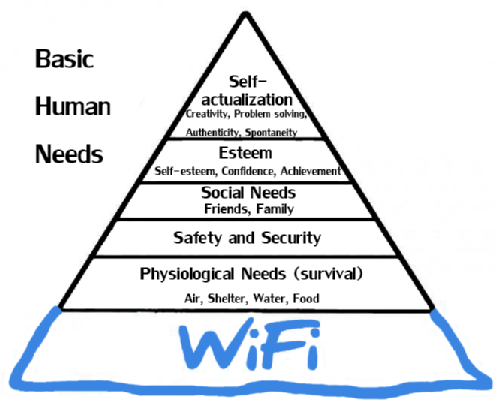
There is a connecting theme here, I believe. Information has come to be seen as a commodity- a need as basic as food and drink. Someone has even amended Maslow's heirarchy of human needs to include WiFi. However just because something is a basic need doesn't mean that the more of it you get the better. Take food for instance, and our current Western society's troubled relationship with it. And whilst lack of information leads to disempowerment and alienation from society, more information (after a certain point) emphatically does not lead to the opposite. Because information, like chocolate, can become psychologically addictive so that we binge on it and make ourselves unwell.

Perhaps that is an exaggeration, as things stand, but project forward just a little into the future. I can envisage a time when implantable sub-miniature sensors can provide us with a constant stream of real-time data about every important function of our body- blood pressure, heart-rate, blood sugar levels, even the levels of stress hormones. They will be popular I imagine, and sold as invaluable aids to maintaining a truly healthy lifestyle (on a minute-to-minute basis!) But can you imagine how unhealthily addictive such information might be? There are plenty in our society who are becoming neurotically health-obsessed as it is and this would take it to an entirely new level. And imagine if one of the implantable sensors failed- the blood pressure one for instance. What would that do to one's actual blood pressure?

And if that isn't a nightmarish enough thought, what about going one step further? What if implantable sensors could assess and feed back information about the functioning of one's brain itself? The state of one's mood; how negative one was feeling; whether one was falling prey to irrational thoughts. Ludicrous? Certainly. Impossible? Probably not.

The thing is of course that information once it exists cannot be destroyed. Not really. Not as long as someone wants to retain it. What can happen to it though is that it can be ignored. It seems a basic human desire to know more about the world around us. We are an inquisitive species- it is probably that as much as anything else that has led to our rapid development- but we can choose occasionally not to be inquisitive. Not to ask. Maybe even not to to want to know. It is getting increasingly hard, but it is possible. There are those in our children's generation who quite deliberately go "off grid." Who close their social media accounts, throw away their smartphones and resort to those ancient and inefficient means of gathering information about the world: their five senses.

And maybe they've got it right.


Monday, 9 March 2015

How you can watch a film without seeing it

Here's an odd thing. I watched Cool Hand Luke the other night and it was as if I had never seen it before. Not that I had forgotten it, just that I don't think I ever really saw it properly the first time I watched it. In my memory it was one of those 60s/70s all-American movies about a maverick hero, somewhere on the continuum between One Flew Over the Cuckoo's Nest and The Good, the Bad and the Ugly. I recalled two specific scenes from it- the egg-eating bet and Paul Newman singing "Plastic Jesus." Both of these I remembered as sort of absurdist and anti-heroic in the best traditions of these sorts of films- Paul Newman as the ultimately unknowable Man With No Name.

And then when I watched it again all these decades later it had become a film all about faith and the loss of faith, with an almost didactically precise relationship to the key themes and concepts of Christianity. For a start, Luke (the central character) is much exercised by his own loss of faith. That is what the scene of him singing "Plastic Jesus" is all about. He has just heard that his mother has died, and sits alone on his bunk bed with the banjo that is his only physical reminder of his home life singing a song about the absurdity of religious faith- or at least the sort of faith that means that "going ninety I ain't scary/So long as I got the Virgin Mary/Assuring me that I won't go to hell." Newman's last scene takes place in a church where he has gone to confront God, addressing him as "Old Man" and concluding that he is a "bit of a hard-ass too." It is there that he is shot and killed.

The film is not just about Luke's loss of faith either- it is about the process by which we all construct and abandon figures on who we fasten our faith. Luke is a quite explicitly Messianic figure in the film- achieving victory through physical suffering and performing a variety of miracles which turn him into an object of bemused veneration amongst the other men. Miracles? Well, yes. There is the miracle of the fight with Dragline, in which Luke wins by means of being beaten so severely and relentlessly yet refusing to give up that Dragline eventually walks away, subsequently becoming Luke's greatest disciple. There is the miracle of the poker game when Luke transforms a collection of "nothing" into the "cool hand" that gives him his name. Then there is the miracle of the road, when Luke transforms the attitude of the work gang and changes the unending task of tarring the road into a joyous celebration that makes the road (in the men's own words) disappear.

Finally of course there is the miracle of the eggs. To win a bet, Luke eats fifty hard boiled eggs. It is an intensely unpleasant physical trial, in which his stomach becomes distended and taught as a drum and he is left virtually comatose. Yet even though the effect of his actions in the short term is to deprive most of his fellow inmates of their hard earned cash it is pretty clear that this act of near-martyrdom is in a sense done for the benefit of the other men. The number fifty is hardly accidental- we are frequently reminded that there are fifty inmates in total in the block- and the image of Luke at the end is explicitly Messianic- lying on his back, his legs crossed at the ankles and his arms stretched to either side.

The film is not so much about Luke as Messiah though (whatever some presumably Christian websites would have you believe). It is about the other men's faith and loss of faith in him. From early on they see him as different to them, and particularly once he has successfully escaped (before being betrayed and recaptured) they begin to venerate him. Dragline receives a photo of Luke on the outside, with two girls, and it becomes almost a religious icon- another inmate paying Dragline an entire bottle of soda for it. When Luke returns he is exasperated by the other men's idolising of the symbol he has come to represent and tells them that the picture is a "phoney" but it makes no difference until the guards' relentless sadism eventually breaks him and he hangs onto their legs and begs for mercy.

Here we see the bitter loss of the other men's faith, symbolised by the tearing up of the iconic photo. They become dispirited and lost as Luke toadies to the guards, as if the breaking of his spirit has broken something profound in them too. Eventually Luke escapes again, and it is in the penultimate scene that the Messianic parallels become most explicit. In the aforementioned church, and as Luke is communing with his "old man" he is betrayed by Dragline (as Judas), who brings the police and prison guards to him, leading to his shooting by "the man with no eyes", an enigmatic symbol of relentless oppression. Our last sight of Luke is in the back of the prison officers' car. He is alive, but clearly not for long, and an enigmatic smile plays on his lips. And as the car pulls away the "man with no eyes" mirror sunglasses are crushed under a wheel, symbolising Luke's eventual and paradoxical victory over death itself.

The last scene though is, in a sense, the most telling. Here Dragline is regaling other inmates with an account of Luke's life and death and here, it is clear, the process of mythologising him reaches its conclusion. Lukehas been transformed in death from a fellow-inmate to a symbol of death and resurrection and we are left, thanks to Dragline, with a series of still images of the strange and distant smile that defines his character throughout the movie.

So why didn't see all this the first time I watched the movie? It seems almost painfully obvious now, but maybe I just wasn't experienced enough at stepping back from a story and seeing it in the light of this sort of symbolism. The fact is I enjoyed it then- recommended it to friends and remembered the lyrics of the Plastic Jesus song almost perfectly. So what does that show?well maybe that it is indeed perfectly possible to watch and enjoy a film without really seeing it.


Monday, 2 March 2015

Something sad is happening to schools

Having left the schools sector three years ago I have had little direct contact with it until just recently. Over the last few weeks though I have met a number of people who are still, or were until just recently, teachers. Their stories are all different but the overall impression I have got from them has been sadness, and to some extent regret at having given over their lives to teaching.

This is not a post about how hard-working and stressed teachers are. I think for decades we overplayed that hand, without understanding the stresses and difficulties other professionals face and with insufficient appreciation of the 11 weeks of annual holiday. However it is interesting that British teachers have always had that sense of themselves. It is, I think, no coincidence that of all the countries I know anything about Britain is the one in which teachers are given the least automatic respect by the rest of society. So perhaps it has been in response to this that British teachers have long defined themselves instead by their masochistic insistence on their own levels of hard work and stress.

I freely admit that banging on like this has probably not, over the decades, won teachers a great deal of sympathy and I do not want to re-enter the old and pointless debate about just how comparatively hard teachers work compared to other professionals. The fact is though that teachers are (and throughout human history always have been) crucial to the future of society, so it matters how they feel about their jobs, because how they feel about them partly determines how well they do them, and how well teachers do their jobs affects an entire generation.

The problem is, if the current and recently ex-teachers I have met recently are anything to go on, then how teachers feel about their jobs at the moment is not encouraging. Of course there are people in all sorts of jobs who are pissed off, bored, over-stressed or just knackered, and negativity about your work is far from confined to teachers. What I am talking about though is something different. The staff I have talked to weren't so much whingeing about how hard they were (or had been) working or complaining about the pace and scale of change, or even bemoaning the lack of recognition for their hard work. What they seemed to be saying, and what marked these conversations as different to me, was that it all seemed such a shame. They weren't so much angry or frustrated or bored or exhausted. The only word for how they seemed to me to feel was the one I used at the start of this post: sad. They were variously sad that the job just didn't have the sense of purpose it used to, sad that skill and effort seemed no longer to be recognised and sad that children no longer seemed to be at the heart of what they did.

Perhaps this should come as no surprise. Sir Michael Wilshaw, the head of Ofsted, once memorably told a group of headteachers that "If anyone says to you that 'staff morale is at an all-time low' you know you are doing something right," and Michael Gove expressed his antagonism towards the teaching profession (the core of what he called 'the Blob') even more directly: "As long as there are people in education making excuses for failure, cursing future generations with a culture of low expectations, denying children access to the best that has been thought and written, because Nemo and the Mister Men are more relevant, the battle needs to be joined."

It is not just denigration from the powers that be that has saddened teachers though. The near-universal academisation of schools has stripped out many of the extended learning communities that teachers relied on to validate their practice and their sense of themselves as valued and valuable contributors to the fund of human understanding. Curricula that teachers have committed to and helped to shape over decades were swept away by Michael Gove in favour of anti-intellectual 'traditional' structures in which rote-learning again has a place and teachers reduced to transmitters of static knowledge.

The best and most successful private sector companies have learned that the path to innovation and improvement lies with empowering and listening to ordinary employees, thus securing their buy-in to the ethos of the organisation, and also learning from their on-the-ground expertise. Programmes like Undercover Boss may be artificial constructs but the thinking behind them is what lies at the heart of any properly forward-looking company.

Yet in schools there seems to have been a relentless effort of recent years to push in the other direction. Heads have been encouraged to become more draconian with their staff, to stamp out 'merely satisfactory' performance (and performers). Teachers' innovative and thoughtful ways of supporting students into and through their GCSEs have been denounced as virtually cheating and the target culture, which has been so widely derided elsewhere, has become the be-all and end-all of everything in teachers' professional lives. Teacher communities of various sorts (Local Authority based, exam syllabus based, curriculum development based) have been demolished as the unprecedented centralisation of both curriculum development and school organisation has taken hold.

And where in all this is the scope for individuality, for creative thinking and for active commitment to the school, the local community and the children with all their varied needs? No doubt there is still excellent teaching going on and no doubt there are staff who live full and rewarding professional lives. The thing is though, if I were still a teacher in the schools sector I might well be tempted to do as many of those I have recently met have started doing- put my head down, keep quiet and hope nobody noticed me too much. That way I might be able to make it to retirement and the still reasonably generous teachers' pension without my job taking an excessive toll on me.

The thing is, is that what we want the nation's teachers to be doing? Maybe it isn't too late to reverse what I suspect may be a catastrophic collapse in ordinary teachers' sense of playing a crucial role in the massive project of finding the best way to educate the nation's children. What would be needed though would be a Secretary of State for Education whose starting point was not that Britain's school system is broken and needs radical reform or that the means to do so was principally about disempowering the entire education establishment and taking the reins entirely into his or her own hands.

What we would need instead is someone who is prepared to listen to teachers again, to give them a voice and the fora in which to develop and express it. We need someone who can convince teachers once again that what they are doing is important and worthwhile and valued- that they can and should want to learn how to do it even better, but that the best people to help them do that will inevitably be colleagues in their and other schools. We need someone who sees exams and assessment as something that teachers should be central in shaping, rather than, as now, something to catch both students and teachers out and discover their inadequacies.

What we need is someone whose commitment is to the development of education in this country rather than the development of their own career through taking on the education establishment.

Sunday, 18 January 2015

Is David Cameron not simply arguing for the right to bully?

Like much of what David Cameron says, his response to Pope Francis' condemnation of 'provocation' by Charlie Hebdo in its 'survivors' issue' sounds quite reasonable. Until you think about it for a while.

His argument is that "there is a right to cause offence about someone’s religion" (or anything else) "as long as it’s within the law." In a sense of course this is a truism: if something is not against the law then it is not against the law. However Cameron seemed to be exhorting the right to cause offence as a mark of a free society and seeing the law as the sole arbiter of whether one should exercise that right or not.

You see I think there are two issues here that Cameron and others are dangerously conflating:
1) Should the right to free speech (even where that free speech causes offence to some) be defended? and
2) Should people be encouraged to use their right to free speech to offend others?
For me the answer to the first question is manifestly Yes, but the answer to the second is Absolutely not. Or rather, people should be encouraged to cause offence to those who hold power and dominion over them (or others) and use it unfairly, but to cause offence to no one else.

David Cameron has of course put a caveat into his exhortation of the right to offend, namely that it applies only so far as is allowed within the law. On the face of it, does this not negate any possible danger? Well no. And in fact for me it points up the fundamental issue here.

The fact is that laws are written by those in power, so inevitably they are likely to reflect the morals, attitudes and priorities of those who define them, and this is where the problem lies. In previous generations in this country, when homosexuals constituted an oppressed minority, there were no laws against homophobic insults. So in David Cameron's formulation any right-minded person should have defended the right of small-minded bigots to use terms of homophobic abuse towards anyone they felt was insufficiently macho. The same applies to racial minorities. Would David Cameron have defended the right of B&B owners in the 60s to put up signs saying "No dogs, no blacks, no gypsies"?

Or if you want a more extreme example, there were no laws against anti-semitic language in Nazi Germany (or I imagine in present-day Iran). Should the right of citizens in those jurisdictions to cause offence to people of Jewish heritage be defended?

Thankfully the right of present-day citizens of this country to offend people on the basis of their sexual orientation or racial background is severely curtailed. I am eternally grateful that it has been deemed unacceptable to use the racist words that I know deeply offend many black and asian people or the homophobic language that in the past used to eat away at the self-esteem and confidence of gay people. It would (thankfully) be unthinkable now to tell a black girl who has been called a nigger that the person saying it had the right to free speech and she simply had to live with the offence it caused if she wanted to get by in this country.

So why does the same logic not apply to a young muslim girl who has been hurt and offended by the breaking of one of the central taboos of her religion?

The answer is simple. It is because the views of the muslim community as to what does or does not constitute unacceptable offence are not yet well represented (or even understood) amongst those in power who write our laws. That is not particularly surprising- a few decades ago the same was true of homosexuals or those of black or asian origin.

Yet surely, even before the law deemed it to be unacceptable the right-minded in our society did not defend the right of bigots to use racist or homophobic insults, did they? Yes, people like Bernard Manning peddled their filth to large audiences, but would any prime minister of the day have responded to outrage in the afro-caribbean community with a sanctimonious "there is a right to cause offence ... as long as it’s within the law"? The powers-that-be were guilty of even worse blindness to the offence caused to their society's underclasses than are today's but would they honestly have gone on national television to hail that blindness as a principled commitment to free speech?

The thing is, David Cameron's line is really nothing more than a bully's charter. What he is saying is that until and unless the powers-that-be step in to defend a particular group they are fair game as regards causing offence. He comes close even to encouraging that offence (that abuse) as the defining feature of a free society.

There is (as far as I am aware) no specific law forbidding the causing of offence to Jains- members of an ancient religion that prescribes a path of non-violence towards all living things. Devout Jains wear mesh over their mouths to avoid inhaling and accidentally killing flying insects and walk barefoot to avoid crushing ants and beetles. The death of any living thing is a source of distress to a Jain.

Let us suppose that someone took against Jainism for some reason, and stationed themselves at the door of a Jain temple spraying insecticide in the air and scattering ant-killing powder on the ground. Say they went further and set up a (legal) abattoir next door, for the sole purpose of causing offence to the worshipers. Would David Cameron go on national television to defend that person's right to cause offence and distress in that way?

Myself, I think that one of the key markers of a civilised society is that people behave in a civilised way, whatever the law may or may not permit them to do. I am not so prudish as to wish to outlaw the causing of any offence to anyone, but in a civilised society the boundaries for such causing of offence are drawn not by what is deemed legal by those in power but by what is acceptable within the universal code of human interaction: do as you would be done to. And whilst causing offence is sometimes part of the natural cut-and-thrust of a vibrant society causing distress never should be.

The thing is, the less like oneself another person is the less certain one can be as to where they draw the line between offence and distress. And in such a situation it behooves all of us (and most of all our prime minister) to adopt the precautionary principle. If you are not sure whether what you are saying (or drawing) will cause offence or actual distress, then DON'T DO IT.

Whether it is against the law or not.

Friday, 9 January 2015

Does this mean war?

Much of the commentary I have read about the Charlie Hebdo atrocity seems to present it in the context of a vast ideological war which is perceived to be brewing between the (variously) medieval, barbaric or fanatic Islamist jihadis and the liberal, democratic West. Even comment such as my previous post that criticizes some of the values or approaches adopted by the Charlie Hebdo cartoonists have taken it more or less as read that the actions of these two brothers have a crucial importance for the future of the world. Terrible as the killings were, there is a strong sense that they are merely a foretaste of what might come and that effectively war has been declared (though it is not clear by whom).

In the wake of an appalling and shocking tragedy such catastrophic thinking is hardly surprising, but it does behoove us I believe to stand back a little and seek some sort of objectivity. When Adam Lanza shot and killed 26 people at Sandy Hook Elementary School just over two years ago I don't remember the language of warfare being used. Yet his was by no means the first and will not be the last mass killing in a US school, and together such shootings have killed 111 and injured 123 since 2010 alone.

The thing is, that Adam Lanza and his like can only very rarely characterised as "other" in the way that Cherif ands Said Kouachi all too easily can. So school shooters can be contained with labels such as mad, disturbed, alienated and loner that somehow diminish the threat they pose to civil society in the US. Yet they are, objectively, more of a threat than those such as the brothers Kouachi. It is not just that school shooters and the like have killed far more people in the West than jihadi terrorists. They have also (to me bizarrely) fueled the US citizenry's desire for liberal gun possession laws, with all that that implies in terms of the breakdown of civilised values.

So in discussion of the appalling incident in Paris, please let us avoid the language of "us" and "them", unless "us" comprises the vast mass of law-abiding, tolerant citizens of whatever religious persuasion and "them" includes both the brothers Kouachi and Adam Lanza and his ilk.


Thursday, 8 January 2015

Suis-je Charlie?

Yesterday's attacks on the offices of Charlie Hebdo in Paris were utterly horrific and indefensible, that goes without saying. It is not just the actions themselves that were appalling but the motivations behind the actions- this was an attempt to use brutal violence to suppress free speech, to impose a particular ideology and to drive a wedge between Islam and the rest of the world. The current crop of ruthless ideologically motivated terrorists are not the first of course, but it is a long time since the Red Brigade or the Bader-Meinhoff gang carried out similar atrocities and in the current world of instant global media we all feel the shock and outrage all the more keenly.

I hope that nothing I write here in any way softens the condemnation of those who carry out, or intend to carry out, such barbaric and anti-democratic acts of violence.

However there are are other questions to be considered here, and for me the main one is raised by the social media response that takes the hashtag #JeSuisCharlie as its rallying cry. This is the (understandable) response of many to align themselves with the intentions and values of the victims of this outrage. There is a solidarity in this that I find heartening, even uplifting, but it raises questions too.

France has a tradition of crude and brutal satire that would shock citizens of many other countries. In fact Charlie Hebdo, like its more successful counterpart Le Canard Enchaîné, revels in its ability to shock and disgust. Its ethos is defiantly iconoclastic and it uses satire to tear down anything with any pretensions to power or influence. Its journalists and cartoonists, many now tragically gunned down, were utterly unafraid of controversy and intimidation and continued to publish despite actual firebombing as well as a multitude of threats.

So what is there to criticise? Is Charlie Hebdo not then a manifestation of democracy and free speech at its rawest and finest?

Well, there is another side to it too, and it is worth considering Charlie Hebdo's attitude to organised religion specifically. France has a vibrant tradition of secularism and specifically religious iconoclasm, and many of Charlie Hebdo's most outrageous cartoons have aimed at the heart of organised religion- all organised religion. They have published cartoons of masturbating nuns and the pope in a condom, as well as many others. For French secularists organised religion is a fundamentally oppressive force that has to be repelled by any means possible to retain the national commitment to liberté, égalité and fraternité and Charlie Hebdo has been at the forefront of that struggle for many many years.

Recent cartoons lampooning Islamic symbols and values are well within that tradition of course, so should they not simply be applauded as part of an attempt to normalise public attitudes towards Islam by demonstrating that Islam, like Christianity and Judaism, is susceptible to humorous and satirical comment? Or should they be seen, as many moderate Muslims see them, as almost the opposite- as an attempt to force them and their values out of modern Western society? Is this satire, or is it bullying?

For me the key consideration in this question is that of power. Where satire is used against entrenched power I would defend it no matter how outrageous or distasteful it becomes. However the position is very different when it used by the powerful against their enemies, and even against those they oppress. The Nazi parties were great users of satire against the Jews- so would we defend the right to free speech of creators of cartoons such as this?

Not that I am saying that Charlie Hebdos offerings are remotely similar of course, but attacking another's religion is very different from attacking ones own, particularly when the religion one is attacking is that of the poorest and least empowered citizens of ones country. Iconoclasm is literally the destruction of venerated images, and whilst doing this within ones own church is clearly an act of defiance, doing it in someone else's can veer close to cultural intimidation.

In the aftermath of incidents such as yesterday's it seems to go without saying that free speech must lie at the heart of any civilised community's values. Yet a moment's thought calls that assumption into question. Should a civilised nation defend the right to free speech of internet trolls? Of the perpetrators of racial hatred? Of the distributors of paedophile pornography?

And if it doesn't, who gets to determine which speech should be free and which suppressed?

I heard the view expressed this morning that the correct response from those offended by something like Charlie Hebdo's mohammed cartoon should be made not with guns but with other cartoons. The thing is, whilst I absolutely agree with the first part of this formulation, the second part is nonsensical. You see, for all their iconoclastic, anti-authority, revolutionary ethos, cartoonists such as those so brutally killed at Charlie Hebdo were and are central to the educated, white 'ruling classes' they lampoon. Whenever they wish to tear down, to attack and to mock they have the means at their disposal- they simply go into print. How many muslims offended by their attacks on symbols central to their world view have the same option?

The ideology of those who respond to any statement of which they disapprove with murderous violence is as incomprehensibly barbaric as President Hollande said. However that does not by definition imply that its victims were justified to exercise their right to free speech in the way they did. Islam is not an organised religion in the way Catholicism is and in general its adherents are not in positions of power in Western society to the extent that adherents of Christianity or Judaism are. So attacks on Islam veer uncomfortably close (for me) to attacks on the belief systems of the disempowered and marginalised rather than on the wielders of power.

True, Islam needs to be normalised within Western society, and its ethos and values need to come to terms with values such as those of free speech, equal rights and pluralism, just as the world's other religions have had to. It needs to change and it needs to expunge its extremist and repressive elements (mind you, if it does succeed in doing that it will be doing better than Chrisitanity). But to what extent will viciously sardonic, borderline racist satirical cartoons drawn by world-weary representatives of the cultural establishment help in that process?

  I condemn utterly the killers of the Charlie Hebdo cartoonists, but I for one will not be using the hashtag #JeSuisCharlie.

Contributors